
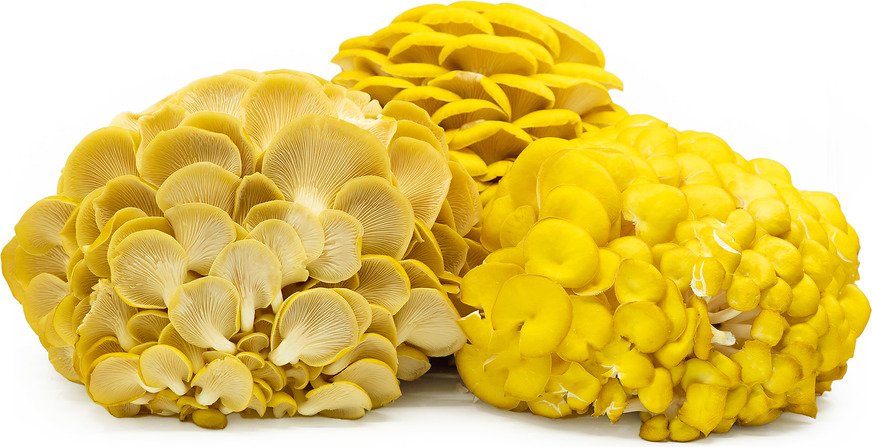
Golden Oyster Mushrooms – Pleurotus Citrinopileatus,
Pleurotus Citrinopileatus, the golden (yellow) oyster mushroom, is an edible gilled fungus. Native to eastern Russia, northern China, Korea, and Japan, the golden oyster mushroom is very closely related to cornucopiae of Europe, with some authors considering them to be at the rank of subspecies.
[Before we dive in, a quick note]:
We hope you’ll enjoy learning about mushrooms as much as we do! Please know that all information shared here by The Cottage Garden is for educational purposes only and is not meant to provide or take the place of medical advice. It is not meant to diagnose, treat, cure, or prevent any disease.
Golden oyster mushrooms grow in small to medium-sized clumps, sometimes referred to as bouquets, and are comprised of many layers of tightly packed mushrooms growing from a single base attached to a tree. The overlapping caps average 2 to 6 centimeters in diameter and change in appearance, depending on age. Young Golden oyster mushrooms have a flat, plump, smooth, and taut cap with a small indentation in the center and curled edges.
As the mushrooms age, they begin to uncurl and open, developing a funnel-like shape around the indentation. The caps have a curved, semi-circular nature with a velvety, dry, delicate, easily bruised surface. The caps also showcase a pale to saturated, golden-yellow hue, varying with temperature. Underneath the caps, cylindrical white stems range from 2 to 5 centimeters in length and are curved to bent due to their overlapping positioning in the mushroom bouquet. There are also white to ivory gills that extend slightly down the stem, and these gills are widely spaced and have a white spore print. Raw Golden oyster mushrooms easily break apart due to their fragile nature, and the caps have a spongy texture and a bitter, unpalatable flavor.
The mushrooms also have a light and fresh scent that some consumers say smells like watermelon. When cooked, Golden oyster mushrooms develop a fleshy, tender, and pleasantly chewy consistency, release a fruity aroma reminiscent of aged red wine, and have a mild, nutty, and sweet taste with cashew-like nuances to citrus or cinnamon-like undertones, depending on the mushroom’s growing environment.
Nutritional Value
Golden oyster mushrooms contain copper to develop connective tissues, potassium to balance fluid levels within the body, and fiber to regulate the digestive tract. The mushrooms also contain B vitamins to help extract energy from carbohydrates, zinc to protect the immune system, iron to produce the protein hemoglobin for oxygen transport through the bloodstream, and other nutrients, including amino acids, folate, and carotenoids.
Golden oyster mushrooms are preferred for cooked preparations as they develop a tender, chewy nature. When raw, the mushrooms have a bitter, unpleasant taste, but when cooked, the bitterness subsides and transitions into a mild, subtly nutty, and earthy flavor. Golden oyster mushrooms should be gently cleaned with a brush or damp towel, and the stems may be quite bitter to some individuals, in which case they should be removed and discarded.
Once prepped, Golden oyster mushrooms are popularly added to stir-fries, sauteed with butter until crisp, or simmered into sauces. It is important to note that their yellow coloring generally disappears, depending on the preparation and cooking time, but when fried into tempura, the golden yellow hue is maintained. The mushrooms can also be cooked and served with braised meats, mixed into rice and noodle dishes, incorporated into frittatas, served on toast, or added as a pizza topping. In Japan, Golden oyster mushrooms are traditionally added to dashi and soup stocks to build layers of umami to the liquid. Golden oyster mushrooms also become crisp and can be crumbled over dishes as a substitute for bacon. Golden oyster mushrooms pair well with meats such as poultry, steak, and pork, seafood, herbs including cilantro, thyme, parsley, rosemary, and tarragon, aromatics such as garlic, onion, and leeks, asparagus, bok choy, potatoes, citrus, and coconut milk.
Whole, unwashed Golden oyster mushrooms have a short shelf life and should be used immediately for the best quality and flavor. The mushrooms cannot withstand excessive handling and will only keep for a few days when stored in the refrigerator between paper towels in a paper bag.